
Are we becoming a post-literate society? You can probably guess James Marriott’s answer in The New Dark Ages: The End of Reading and the Dawn of a Post-Literate Society. It’s a bleak account. Marriott argues that screens - specifically, television, cable TV, the internet, and social media - are coaxing us into a world without books. Without books, we are becoming post-literate.
Post-literacy is different from illiteracy. We can still read, but we prefer videos and podcasts to writing. This laziness is transforming us from a written society into an oral society. Oral societies think in ways that are more tribal than written ones: they are more forgetful, irrational, superficial, and simplistic. Thus, democracy, and perhaps the enlightenment itself, is imperilled.
I found The Dark Ages extremely frustrating.
Although I presented Marriott’s thesis above as a single argument, the book itself is far more promiscuous. A careful reader will find 8 separate points, fired indiscriminately at the reader’s face like buckshot from a blunderbuss:
Declining literacy means the literature beloved by our grandparents will not be passed on to their Instagram-addled grandchildren.
The rise of screens is making us more socially atomised, more individualistic, more separated from one another.
Screens are causing culture to simplify. Marriott juxtaposes references to Shakespeare, Middlemarch, Henry James, and Chekhov to the inanity of modern best-selling lists, sequilitis, chord simplification: what he calls a “smartphone wasteland.”
Worse, screens are causing culture to degenerate. Marriott works hard to avoid appearing pompous and elitist; nonetheless, he believes we have finally reached a cultural singularity with the indefensible mindlessness of TikTok and AI-generated “slop.”
Unlike books, screens strip us of agency: in Marriott’s words, we are caught on an “attentional leash.” This feeling is strengthened by the megalomaniacal ambitions of attention engineers and their cynical double-standards when raising their phone-free kids.
The decline of literacy is making us dumber and less critical, with reference to PISA scores and the Reverse Flynn effect.
The decline of literacy is also making us more extreme, angry, conflict-driven, populist, partisan, tribal, religious (and less humanitarian): in general, we are moving towards the spooky crystal-clutching conspiracist spiritualist mumbo jumbo end of the spectrum. If 6 is concern over cognitive stupidity (‘post-literate’), 7 is a concern over spiritual-civilisational decline (‘dark ages’).
And thus, the nuclear warning: the end of democracy and the enlightenment. Without a reasonably informed, critical citizenry, neither democracy nor liberalism exist. A non-reading populace means non-reading elite, and thus non-reading politicians. Compare Kennedy to Trump.
What we get is a “media theory of everything”, where smartphones (and television) are roped in to explain everything from Bukele to PISA score decline. This is reckless and unhelpful: even though I agree with some of the points, it is hard to disentangle what is real versus what is projection.
Take number 6: cognitive decline. What does the evidence actually say? IQ scores are falling, but not by very much and not because of television/phones. PISA scores are falling in some countries, holding steady in others, and rising in a few outliers. The overall patina cannot be explained by screens.
First, IQ. We have good records of IQ scores falling in Scandinavian countries since the 1990s, a trend known as the “Reverse Flynn Effect”:
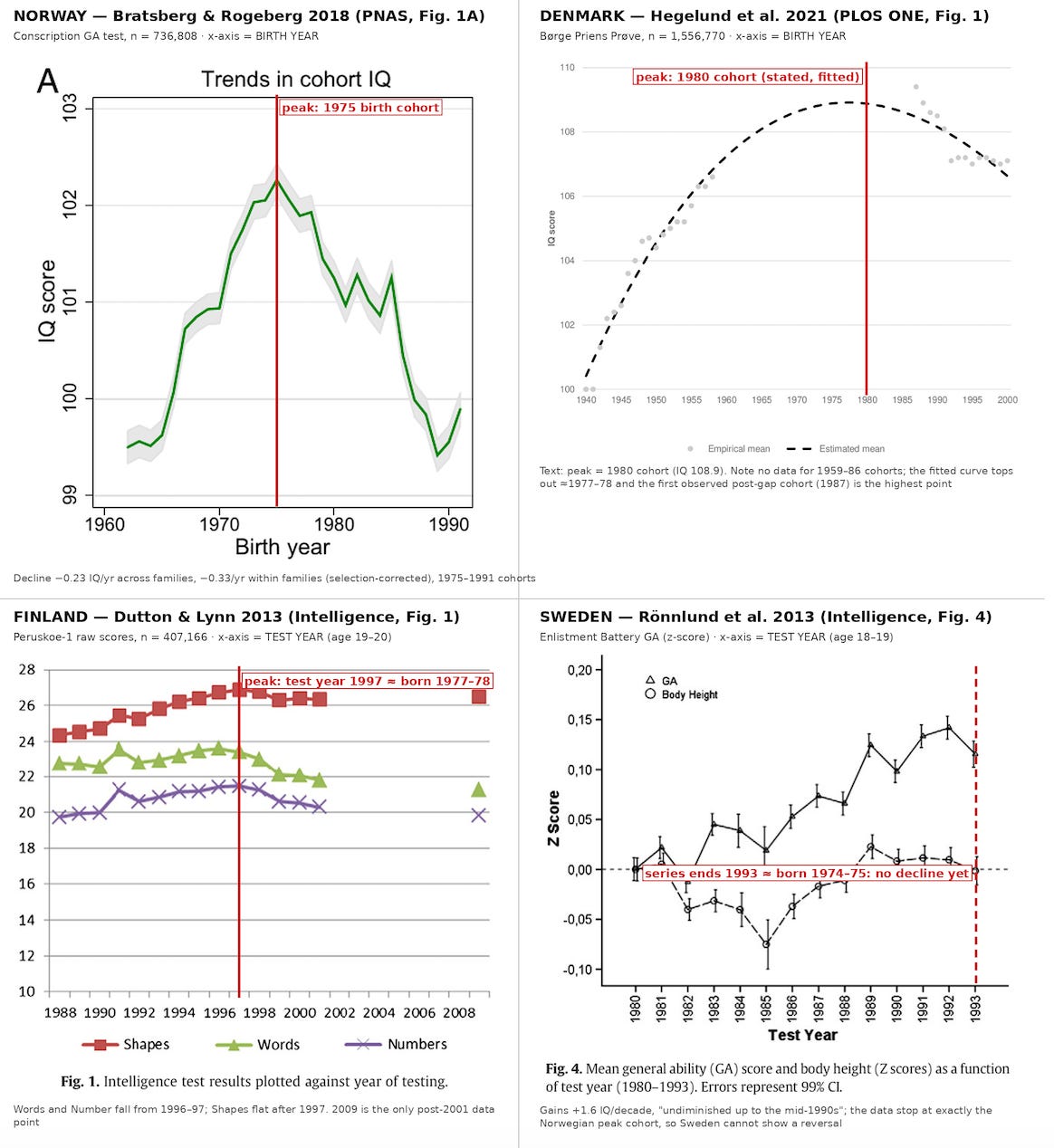
The fall is probably environmental – the reverse Flynn effect occurs within the same families between generations. Could it be television? This would be a little odd since the peak generation was born in 1975, well after television entered our homes. That said, perhaps the increased quantity of television is the cause.
Marriott’s main piece of evidence is a study suggesting that staggered rollout of cable T.V. in Norway reduced IQ. This study, however, shows small effect sizes – approximately 1.4 IQ points for 18 years of television, which the authors admit explains about 12% of the measured fall during this time. Meta-analyses on the effect of Television on literacy show small, if not contextually positive, effects.
Second, PISA scores. OECD reading scores have fallen from around 2012 onwards. This coincides with the mass adoption of smartphones. Causation?
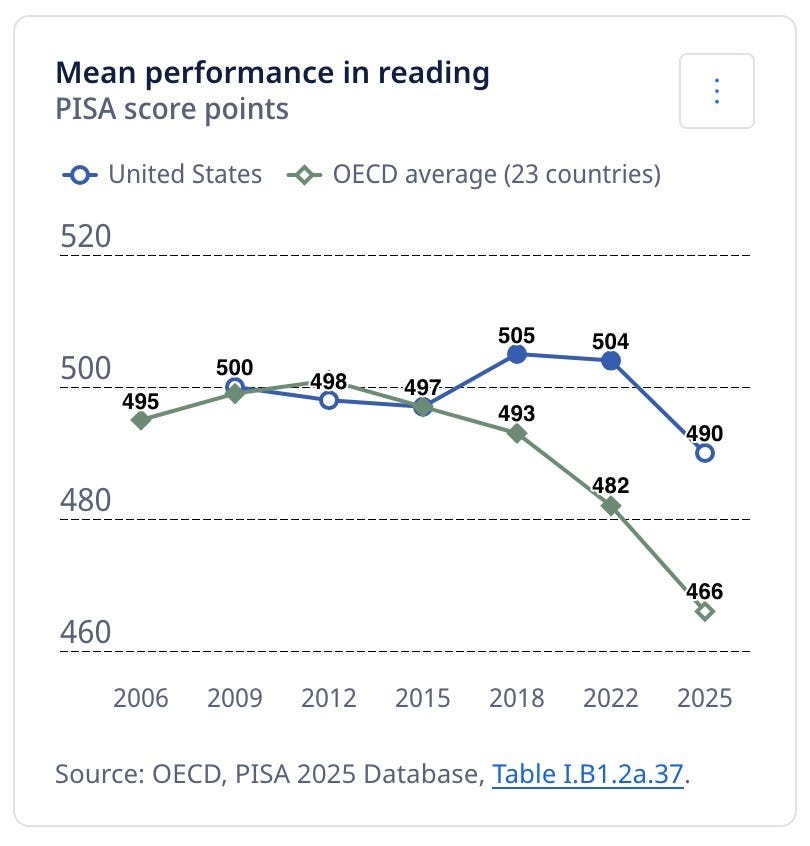
Unlikely. As you can see, US reading scores actually improved after 2012. Similarly, England’s reading scores showed a small increase in performance after 2012 which returned to 2006 levels in 2025:
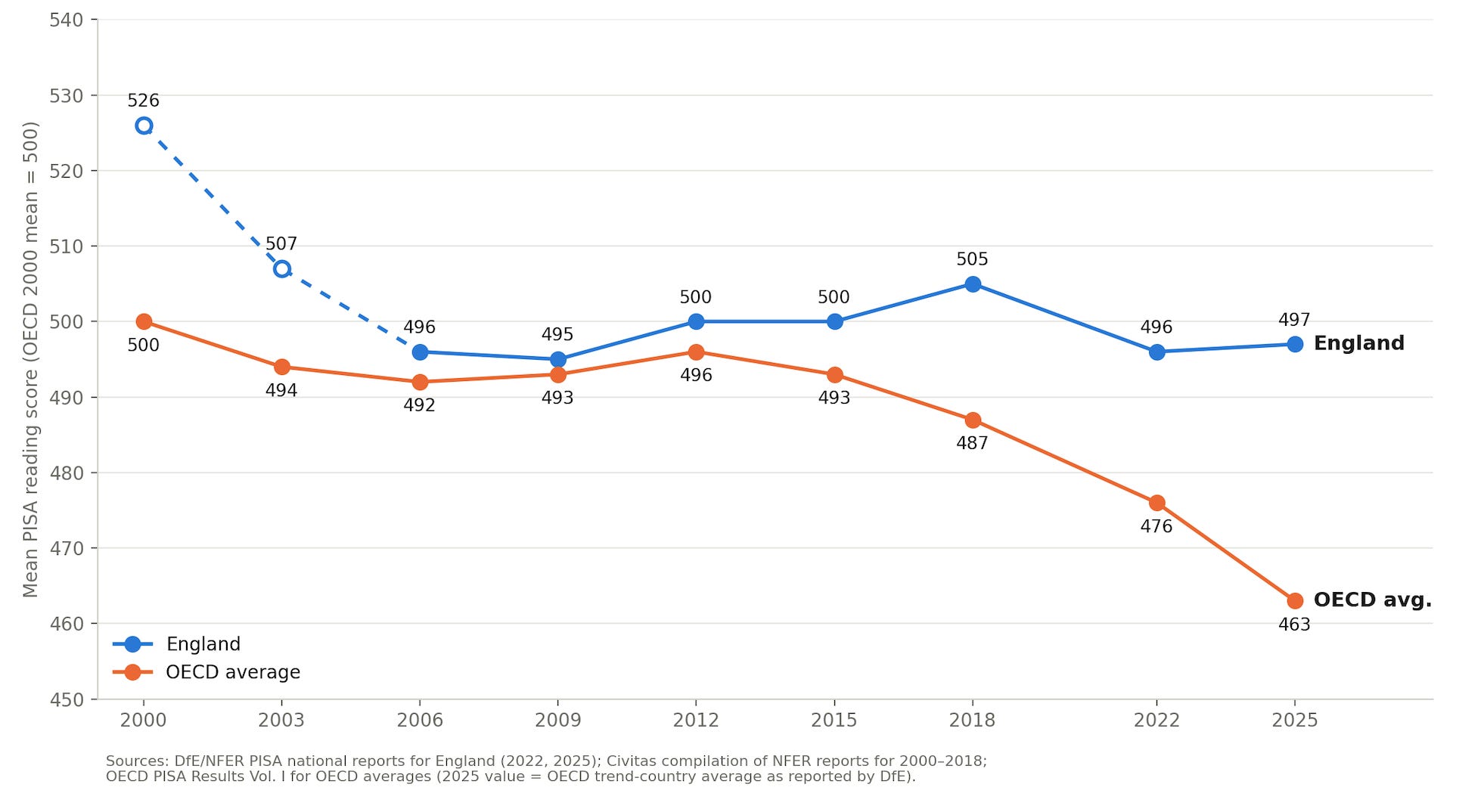
The Dark Ages implies television and phones are the main cause of cognitive decline. This fails to explain the patterns in PISA scores. Why did England and Scotland fall so precipitously from 2000 to 2005 whilst America improved? Why did England and Estonia hold steady after 2015 whilst most other OECD countries declined? How have Singapore, Taiwan, Japan avoided decline altogether?
A better explanation is that a country’s education system is more important than its television diffusion.1 East Asian PISA and IQ scores have probably remained constant, or even risen, because of their rigorous education systems and intensive tutoring cultures. The two European countries which avoid PISA-malaise – Estonia and England – have more rigorous education systems than their neighbours. They (more or less) use the knowledge-rich curricula, direct instruction, and systematic phonics - techniques which their more progressive neighbours abandoned between 1975-1990.
I worry identifying television and social media as the cause of PISA decline will, in effect, exculpate poor education policymaking. “It wasn’t the fault of the curricula we stripped of knowledge, it was the phones!”
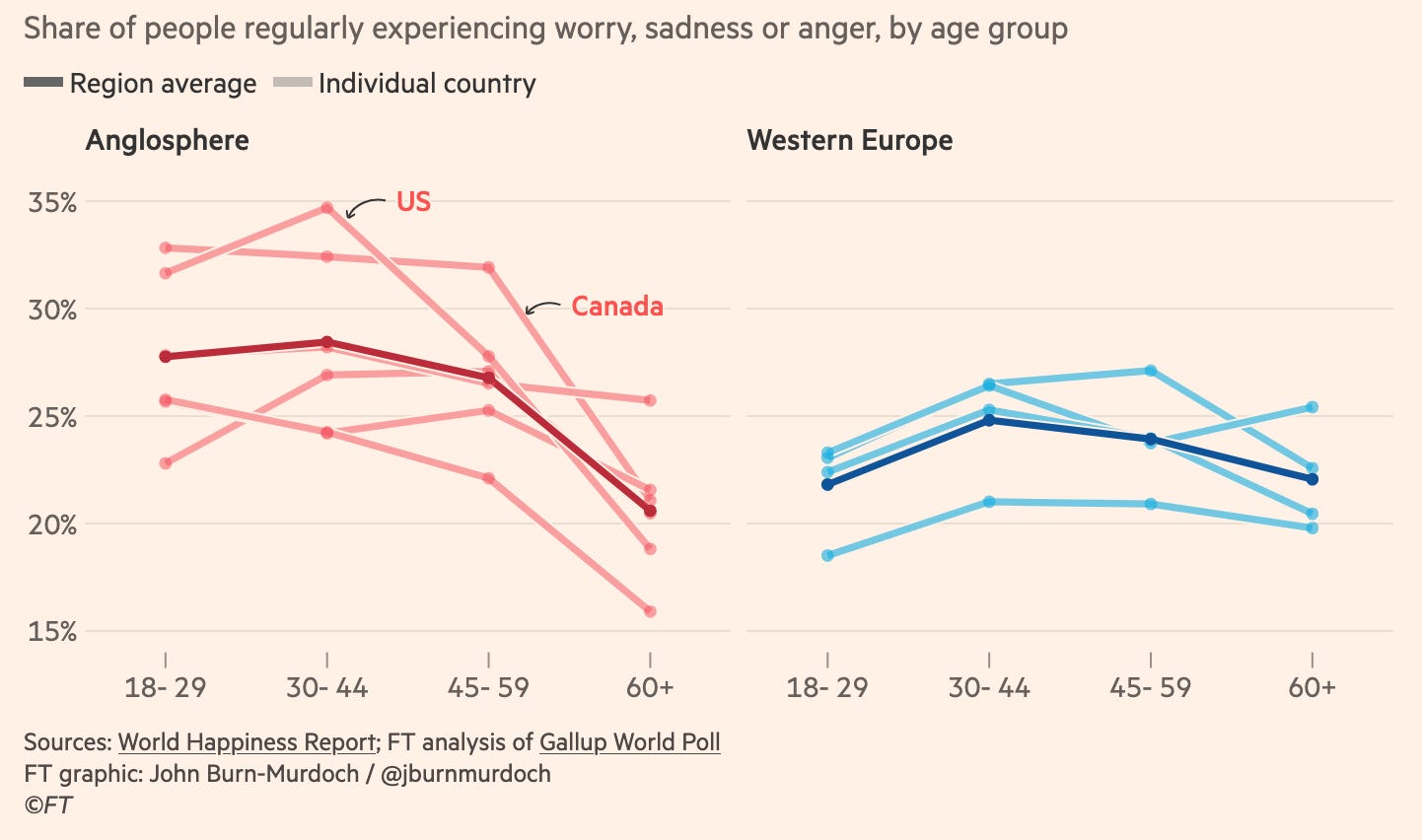
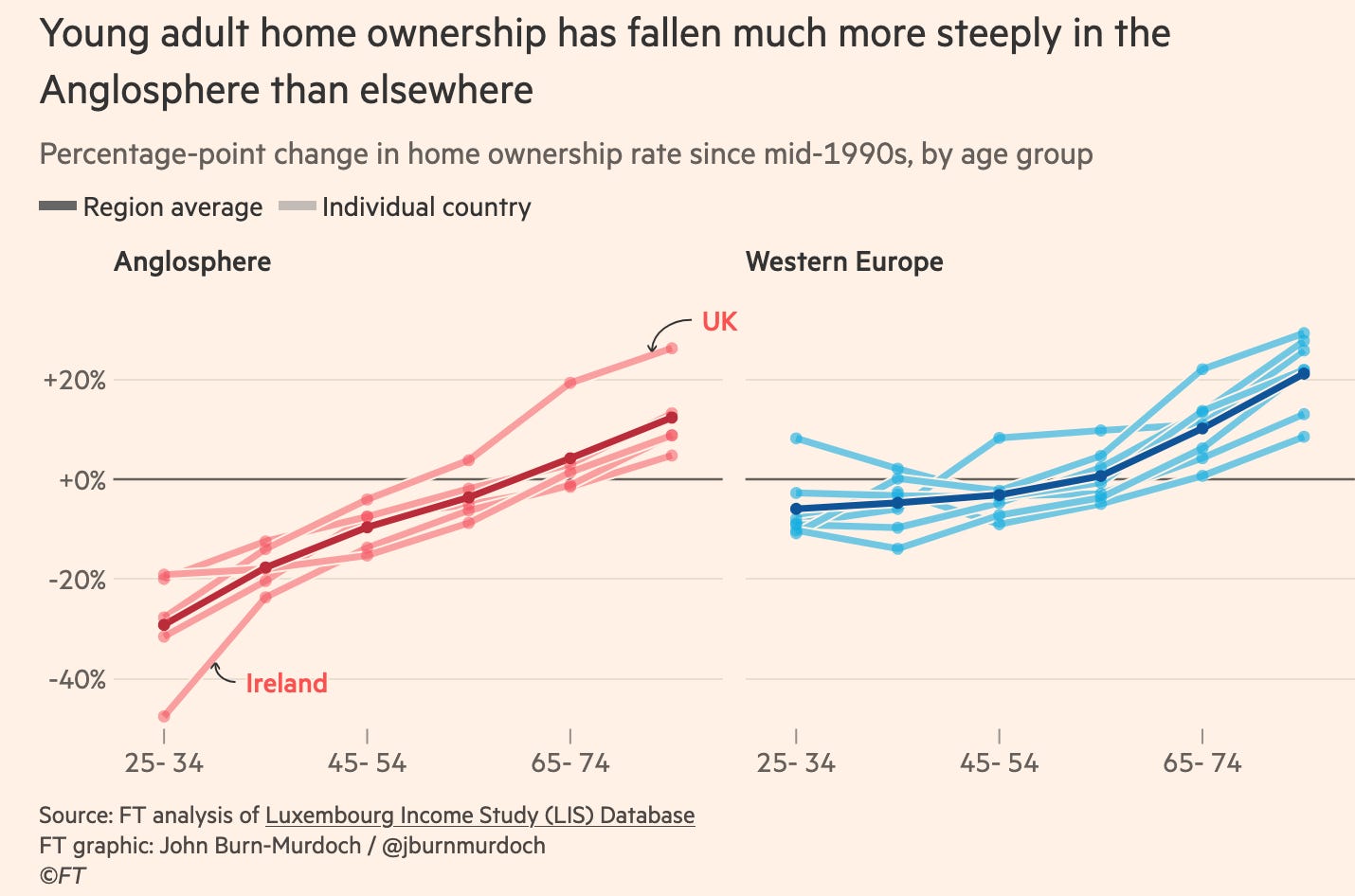
Then take number 7: will phones make us more politically extreme? Unlikely: social media is probably neither necessary nor sufficient for political populism. Within the anglophone bubble, this seems glib, even deluded. Doesn’t arguing online feel very tribal? Isn’t there evidence that anger, conflict, and negative emotions perform better on social media algorithms? Yes, but let’s look outside Britain and the US. The general decline in mental health amongst the young, for instance, is a uniquely Anglosphere phenomenon:
And what of countries which remain politically stable? The politics of countries like Iceland, Norway, Switzerland, Estonia, and Japan, whilst by no means perfect, seem radically different from America, Australia, and Britain despite their cable TV. Perhaps they read more? Not really. Do they buy more books? Nope. Are they more literate? Sometimes – but not always. England has been matching, even exceeding, Norway, Iceland, and Switzerland in literacy scores for years. England has one of the highest reading rates on the planet.
Marriott could have made a more modest causal claim. He could have suggested social media exacerbates populism when it emerges, sustains it for longer, and, perhaps, raises its likelihood of emergence. The problem is that he is committed, via the narrative structure of the book, to the enormous claim that social media is taking us all into “a new dark ages.”
This argument implies that whilst Iceland might seem more stable, sooner or later phones will strip the Icelandic people of their rationality and introduce a wave of superstition, tribalism, and conflict-driven politics. Maybe I am just a complacent Brit, but this seems wildly implausible. Here is a concrete prediction: social media, as it is now, will not radically alter the political discourse of Norway, Iceland or Switzerland in the next two decades.
Again, I worry identifying screens as the cause of populism will distract us from other, more important causes. Marriott notes that populism seems to go alongside high immigration and governance failures. Similarly, I suspect Britain’s stagnant economy and high property prices are more to blame for poor mental health than social media.
All of this promiscuous causal attribution is annoying because it drowns out Marriott’s stronger points. Points 2 and 8 have more than a grain of truth. Television and social media do crowd out in-person socialisation and this probably has knock-on effects for civic engagement. Look at how much time the Average American is spending on their screens:
This argument - albeit in a far more developed form - was made in Bowling Alone back in 1995/2000. If we reset the clock back to 1950, what would happen? I imagine that qua individuals, we would all be pissed off and inconvenienced. I also imagine that communal life would be improved, and thus, plausibly, participation in public life. Instead, we let the magic box push us ever further apart.
I also agree that public life has become ever more moronic and vacuous. Can anyone deny that there has been a dumbing-down of political debate, school curricula, news reporting, and public broadcasting? Floor speeches of the parliament are charades for soundbites and policy debate does increasingly occur on X.com. The discourse of politicians yesterday is almost alien in its sophistication. Marriott sums it up nicely:
Men like Truman and Churchill were not perfect politicians but they benefited from habits of attention, powers of imagination and a deep internalised sense of history that can only be bred by reading. Their successors all too obviously live in a glib eternal present, lacking any ability to think beyond the moment-to-moment goldfish-brained chaos of likes, trends and memes.
Given these arguments - which to me seem incontrovertible - why does Marriott feel the need to throw so much at the wall? Why not mount a direct attack on declining intellectual standards? Here’s the thing: he can’t.
The New Dark Ages has a fatal weakness. Marriott, despite loving classic literature, poetry, and music, refuses to defend “elitist” intellectual standards above TikTok and Reels.2
A recent report issued by the Arts Council, Britain’s most important cultural funding body, warned against the use of ‘terms like excellence’ which may promote ‘unhelpful hierarchies about what kinds of work are valued’.
I have an instinctive sympathy with the democratic spirit of these ideas. Pomposity, pretension and snobbery are unpleasant. Reading books does not make you a good person. Nothing is uglier than sneering at those who do not read. There is value in all kinds of entertainment. To simply turn your nose up at television or computer games or the internet is not a symptom of purity but of tragic incuriosity.2
Marriott is not allowed to argue post-literacy is inherently bad, so he has to link it to other bad things first: decline in IQ and PISA scores, a rise in populism, a decline in socialising, danger to democracy, threats to liberalism. Would the book have the same impact if Chapter 5 was titled “Dumbing Down” rather than “The Disenlightenment”? Or if Chapter 6 was titled “The End of Intellectual Standards” rather than “The End of Democracy”?
This weakness renders Marriott’s recommendations strangely lame. We are repeatedly told a decline in literacy could cause the end of democracy, but all Marriott can recommend is that we treat reading more like exercise. What else can he do? Because he has to accept television and the internet are “valid forms of expression”, they cannot be banned - that would be like banning 1984. They cannot even be the subject of shame - that would be elitist too. So all we get is a floppy prescription to “eat your vegetables… if you want.”
Marriott’s sombre, if not forlorn tone, is familiar to me. I saw the same tone in the Scottish literature examiners I interviewed earlier this year. It is the tone of a group who love something dearly - an entire way of life - but cannot defend it openly. They can barely defend it within the privacy of their own thoughts. They are afflicted with coyness, sheepishness - a shame which saps their strength and stifles their boldness. At one point Marriott describes the end of local newspapers:
Newspaper readers are not only more informed about politics. They vote more, they volunteer more and they belong to more civic associations. When a newspaper dies it rips away with it a whole part of the ecosystem of democratic life, like an ancient rainforest tree felled by loggers.
Marriott and the other champions of readers are like environmentalists ashamed of defending trees. He resembles, in fact, a regressed form of his predecessors: Havelock, Trilling, Davies, and Bloom at least tried to explain why culturally elitist arguments were failing. The New Dark ages does not even do this. Perhaps it cannot; perhaps something has changed since then. This gives Marriott’s writing a new strength - a schizophrenia which sets up the most interesting puzzle of The New Dark Ages:
James Marriott believes post-literacy endangers democracy - perhaps even the enlightenment itself. But he also cringes from any kind of intellectual elitism beyond ‘Tiktok is bad”. So the reader is left scratching their head: what the hell will it take to admit some readers are more sophisticated than others?
Its general intellectual culture may also be relevant. There is a decline British cognitive scores (on Raven’s Matrix) after the 1990s, with the upper class declining less than the lower class. Flynn provides the following explanations:
One looks for consistency of rate of gain both over age and over class and over time. Where this does not occur, we must look for something that impedes the flow of effects among all members of society. These would have to be institutions and subcultures that are age/class specific and powerful enough to insulate their members against general cognitive trends.
Here is what he says about the ‘lower class’:
In other words, upper class peer culture enjoyed an advantage over lower class peer culture in 1980 that had been much eroded by 2008. Could this mean pop culture “corrupted” lower class youth earlier than it did upper class youth?
Marriott continues by drawing the weakest of lines:
But at the same time, this radical cultural relativism has its limits. If we are unwilling to say any pastime is a better use of our free time than any other, we find ourselves marching into the void. The fashionable idea that all entertainment is created equal is incapable of dealing with an age of addictive screen technologies.
Post-literacy *is* inherently bad, and excellence in cultural production is real and good. But literacy isn't correlated in any straightforward way with virtuous behaviour. This is the conjunction of ideas that dare not be held.
It's interesting that Marriott aligns with the Arts Council (o tempora, o mores) in wanting to abandon the ideal of excellence in the name of "democratisation" (a good thing), while the result of this abandonment is supposedly a collapse in democratic values (a bad thing). How are we supposed to square all that up?
I don't understand your objection to argument 7. Marriott is talking about polarization / tribalism but you mix this with mental health, which is really other thing. One can be a super-tribal, polarized and polarizing figure and the same time be very happy. I'm fairly sure there are studies showing that political hardliners report greater life satisfaction than moderates. (As always with political science there will also be studies saying the opposite, but you get my point)
About polarization in particular, it's not just an Anglosphere thing. It has been increasing in mainland Europe for instance.
https://www.suerf.org/publications/suerf-policy-notes-and-briefs/political-polarization-and-gridlock-in-europe-new-evidence-from-high-frequency-indices/
Personally, I think it's clear that a simpler political environment will tend to be more polarized as well. By definition, in a simple debate there is no room for nuance; political arguments are reduced to good vs bad.
More broadly, I agree that some of the book's points are speculative. Marriott himself acknowledges this, e.g. in the section about IQ he says something like "one shouldn't make too much of this, the declines so far have been small".